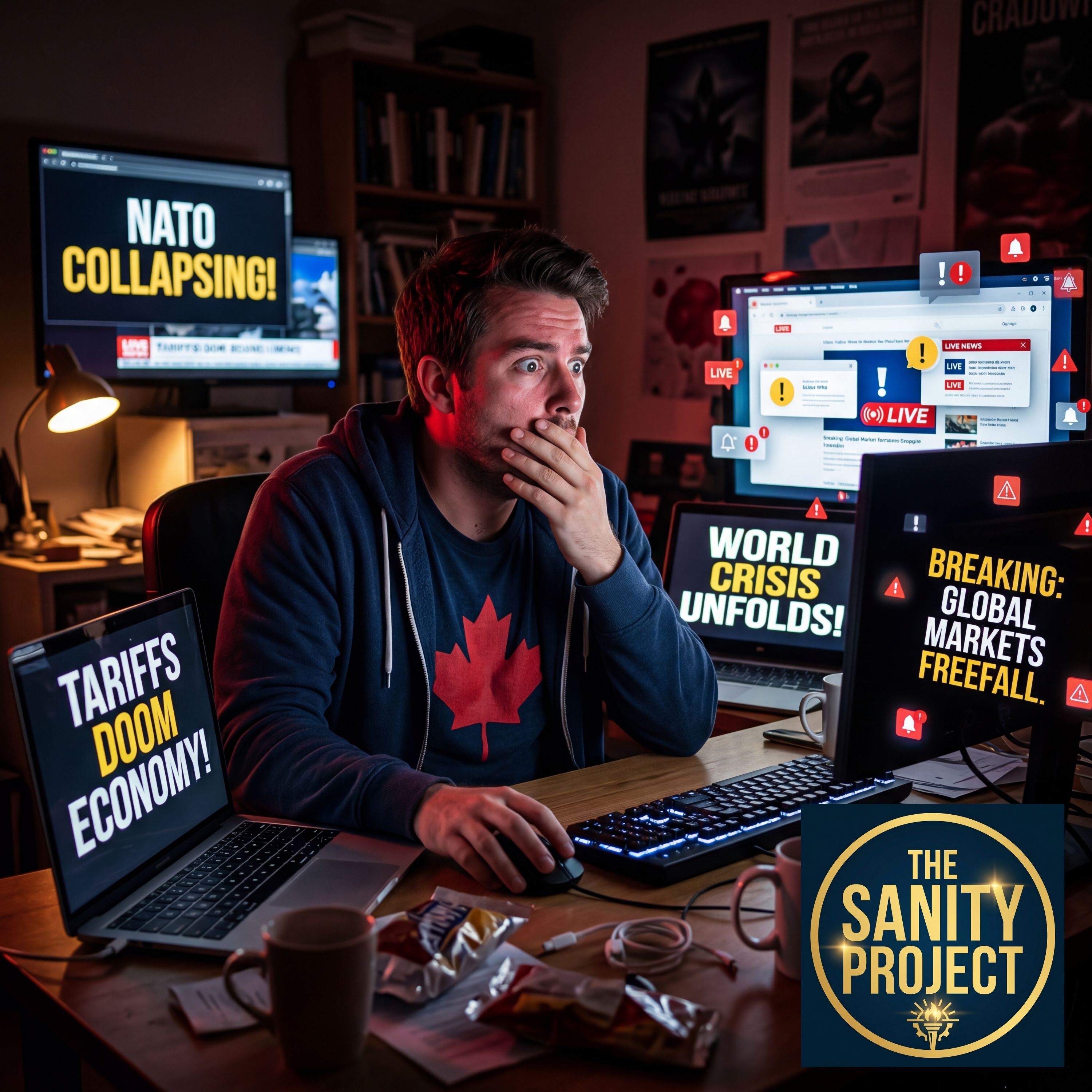
When Panic Becomes Profit: How Canada Can Cut Through the Global Chaos
Let’s be honest—when was the last time you opened your news feed without feeling like the world was ending? Between breathless reports about NATO’s “imminent collapse,” economic apocalypse predictions, and the daily dose of AI-will-kill-us-all content, it’s enough to make anyone want to throw their phone in a drawer and go live in the woods.
But here’s the thing: that feeling of constant crisis isn’t an accident. It’s a feature, not a bug, of our modern media ecosystem. And understanding this distinction might just be the key to maintaining your sanity—and your ability to think clearly about the issues that actually matter.
The Outrage Economy: How Panic Pays
We’re living in what I like to call the “outrage economy,” where engagement metrics drive editorial decisions, and nothing drives engagement quite like fear. Every story needs to be breaking news. Every development needs to be unprecedented. Every policy change needs to be either salvation or doom—there’s no middle ground because middle ground doesn’t get clicks.
Take the recent hysteria around NATO’s supposed fracturing. Yes, there are legitimate concerns about alliance cohesion and differing priorities among member nations. But if you relied solely on social media and sensationalist headlines, you’d think Article 5 was being shredded as we speak and Putin was already measuring drapes for his new European offices.
The reality? NATO has weathered far worse storms. Alliance management has always been messy—that’s what happens when you try to coordinate the interests of 30+ sovereign nations. But nuance doesn’t trend on Twitter, and complexity doesn’t generate ad revenue.
The Canadian Advantage: Cool Heads in Hot Times
This is where Canada’s political voice becomes not just relevant, but essential. We’ve got something many other nations seem to have lost: the ability to take a step back, assess situations without hysteria, and respond with measured pragmatism rather than knee-jerk reactions.
It’s not that Canadians are immune to panic—we’re human, after all. But there’s something in our political DNA that values incremental progress over revolutionary rhetoric, evidence-based policy over ideological purity. Call it boring if you want, but “boring” starts to look pretty appealing when the alternative is constant chaos.
Consider how Canadian media and political discourse has handled recent global tensions. While American cable news cycles through crisis after crisis with the subtlety of a fire alarm, Canadian commentary tends to ask the more fundamental questions: What are the actual facts here? What are the real implications? What can we reasonably do about it?
This isn’t about Canadian exceptionalism—it’s about recognizing that in a world drowning in noise, the ability to think clearly and speak rationally becomes a superpower.
Cutting Through the Noise: Tools for Critical Thinking
So how do we develop this superpower? How do we train ourselves to recognize manufactured panic and respond with reason instead of emotion?
First, we need to understand the mechanics of modern outrage. Most viral panic follows a predictable pattern: a grain of truth gets wrapped in layers of speculation, amplified by algorithms that reward extreme reactions, and then packaged as urgent breaking news. The original facts often get lost in the feedback loop of shares, likes, and increasingly hyperbolic commentary.
The antidote is what I call “productive skepticism.” Not cynicism—that’s just giving up on the possibility of truth altogether. But skepticism that asks: Who benefits from me believing this? What evidence supports this claim? What context am I missing?
Take economic doom predictions around new trade policies. Yes, tariffs have real economic impacts. But the difference between “this will complicate certain supply chains and require adjustment” and “this will collapse the global economy” is the difference between news and entertainment.
The Stakes Are Higher Than We Think
This isn’t just about media literacy or personal mental health—though both of those matter. The constant state of manufactured crisis is eroding our capacity for genuine democratic discourse. When everything is treated as an emergency, nothing gets the sustained, thoughtful attention that complex problems require.
Real challenges—climate adaptation, technological disruption, demographic shifts—require long-term thinking and nuanced solutions. But long-term thinking is impossible when we’re constantly reacting to the crisis du jour. We end up with policy-making that’s reactive rather than proactive, driven by whatever’s trending rather than what’s actually important.
This is where Canadian political wisdom becomes crucial not just for Canada, but as a model for how democratic societies can function in the digital age. We need voices that can cut through the manufactured urgency and focus on what actually matters. We need commentary that values accuracy over virality, context over clickbait.
Reclaiming Sanity in Insane Times
The beautiful thing about critical thinking is that it’s contagious. When enough people start asking better questions—demanding evidence, seeking context, refusing to be manipulated by outrage merchants—the entire information ecosystem starts to shift.
This doesn’t mean becoming complacent or ignoring real problems. It means developing the discernment to tell the difference between genuine concerns and manufactured panic. It means choosing reason over reaction, even when reaction feels more satisfying in the moment.
In a world that profits from your panic, choosing sanity becomes a radical act. And in times like these, a little Canadian-style radical sanity might be exactly what the world needs.
Ready to dive deeper into how we can reclaim rational discourse in our increasingly chaotic world? Listen to the full episode of “Critical Thinking in Chaos | Why Canada’s Political Voice Matters Now” on The Sanity Project Podcast. Because in a world full of noise, sometimes the most revolutionary thing you can do is think clearly.